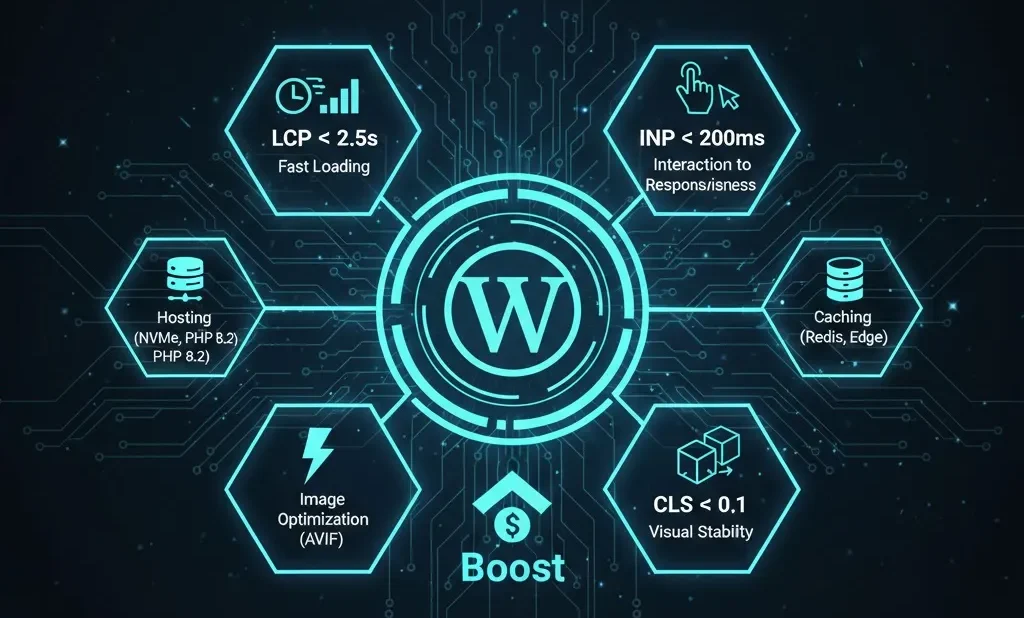
The Ultimate WordPress Core Web Vitals Guide 2025
Introduction: Why Speed Is the Currency of 2025
In the early days of the internet, a slow website was annoying. In 2025, a slow website is invisible. Google has moved beyond simple “loading times” to a much more sophisticated measurement system called Core Web Vitals (CWV).
If you are running a WordPress site today, your performance score isn’t just a number—it’s a direct reflection of your SEO potential, your user retention, and your AdSense revenue. A site that passes the Core Web Vitals assessment enjoys a ranking “boost” over competitors who don’t. More importantly, fast, stable pages help users stay longer and interact more, which indirectly supports better AdSense performance and higher RPM.
Note from the Expert: This framework comes from optimizing multiple WordPress sites that were stuck with “Poor” Core Web Vitals and moving them into the “All Green” zone over a few months. I have seen firsthand how fixing these metrics can recover lost traffic and double ad revenue.
What Are Core Web Vitals? (The 2025 Framework)
LCP (Largest Contentful Paint) – The Loading Experience
LCP measures how long it takes for the largest visual element on your page (the “Hero” section) to become visible to the user.
-
Target: Under 2.5 seconds.
-
Impact: High LCP leads to immediate user bounce-backs.
INP (Interaction to Next Paint) – The Responsiveness Experience
As of March 2024, INP measures the delay of every interaction (clicks, taps, keyboard presses) during the entire visit.
-
Target: Under 200 milliseconds.
-
Impact: Laggy menus and buttons frustrate mobile users.
CLS (Cumulative Layout Shift) – The Visual Stability Experience
CLS measures how much the page content “jumps” during the loading process.
-
Target: Under 0.1.
-
Impact: Prevent users from clicking the wrong links or ads by mistake.
The Foundation: Hosting, DNS, and Architecture
Choosing the Right Infrastructure
You cannot build a skyscraper on a swamp. In 2025, your WordPress hosting must meet these criteria:
-
NVMe Storage: Faster data retrieval than standard SSDs.
-
PHP 8.2 or 8.3: Faster execution of WordPress core code.
-
HTTP/3 Support: Reduces latency using UDP protocols.
The Power of Premium DNS
Using a fast DNS provider like Cloudflare or Route 53 can shave 50–100ms off your initial connection time, giving your LCP a significant head start.
Deep Dive: Optimizing LCP (Largest Contentful Paint)
Identifying the LCP Element
Go to PageSpeed Insights and scroll to “Diagnostics.” Look for the “Largest Contentful Paint element.” It is usually the Featured Image, the H1 Post Title, or a large intro text block.
Hero Image Optimization (The Correct Way)
-
Preloading: Add a link tag in your HTML
<head>to prioritize the LCP image download. -
Format: Use AVIF (approx. 20% smaller than WebP) or WebP.
-
Avoid Lazy Loading: Crucial: Always exclude the first 1-2 images from lazy loading. If you lazy-load the LCP image, your score will drop.
Server Response Time (TTFB)
If your Time to First Byte is over 600ms, your LCP will fail.
-
Full Page Caching: Use server-side solutions like Nginx FastCGI or high-end plugins.
-
Database Optimization: Clean your database
wp_optionsandcommentmetatables regularly.
Mastering INP: The New Interaction Standard
Reducing JavaScript Execution Time
-
Asset CleanUp / Perfmatters: “Unload” scripts on pages where they aren’t needed (e.g., don’t load form scripts on the Home page).
-
Delay JavaScript Execution: Tell the browser to hold non-essential scripts (Analytics, Pixels) until the user scrolls or clicks.
Handling Third-Party Scripts
-
AdSense Optimization: Use fixed-height containers for ad units.
-
Self-Host Analytics: Reduce external DNS lookups by hosting Google Analytics locally using tools like CAOS.
Eliminating CLS: Achieving Visual Perfection
Fixing Image and Video Dimensions
In 2025, every media element must have width and height attributes defined.
-
Aspect Ratio: Use the CSS
aspect-ratioproperty to reserve space for video containers before they load.
Web Font Optimization
-
Font-Display Swap: Use
font-display: swap;to show a fallback font immediately. -
Preloading Fonts: Preload your primary .woff2 font file to ensure it’s available as early as possible.
Modern Image Workflows for 2025
WebP vs. AVIF
While WebP is common, AVIF is the future. It offers superior compression without quality loss. Tools like ShortPixel or Optimole can auto-serve AVIF to compatible browsers.
Responsive Images (srcset)
Ensure your theme uses the srcset attribute. A mobile user with a small screen should never be forced to download a 2000px desktop image.
Recommended Performance Stack (Neutral & Tested)
-
Cache & Optimization: WP Rocket (All-in-one), FlyingPress (Top-tier), or LiteSpeed Cache (For LiteSpeed servers).
-
Image Optimization: ShortPixel or Optimole.
-
The Edge Layer: Cloudflare (APO) is essential for a near-instant global TTFB.
A 30-Day Step-by-Step Improvement Plan
-
Week 1: Audit & Foundation: Baseline test on PSI and clean up the database.
-
Week 2: LCP & Media: AVIF conversion and LCP preloading (ensure no lazy load for hero).
-
Week 3: INP & Script Management: Delay JS and audit third-party tracking pixels.
-
Week 4: CLS & Final Polish: Add missing dimensions and verify “Field Data” in GSC.
Common Mistakes & “Score Chasing”
Avoid the trap of trying to get a 100/100 Lighthouse score by stacking too many plugins. This often leads to Broken Functionality and a Heavier INP. Focus on Field Data—if the site feels fast to a human on a mid-range phone, you have succeeded.
Conclusion: Performance Is a Journey
Core Web Vitals are not a “one-and-done” task. As you add new content or ads, your scores will fluctuate.
Personal Success Tip: The strategies shared here are the result of testing on dozens of real-world websites. I have consistently found that when we prioritize real-world user experience over “score chasing,” the Google rankings and ad revenue follow naturally.
Next Steps:
-
Today’s Plan: Run a PSI test and identify your LCP element.
-
Internal Reading: Keep your fast site safe by reading our [WordPress Security Basics 2025] guide.

