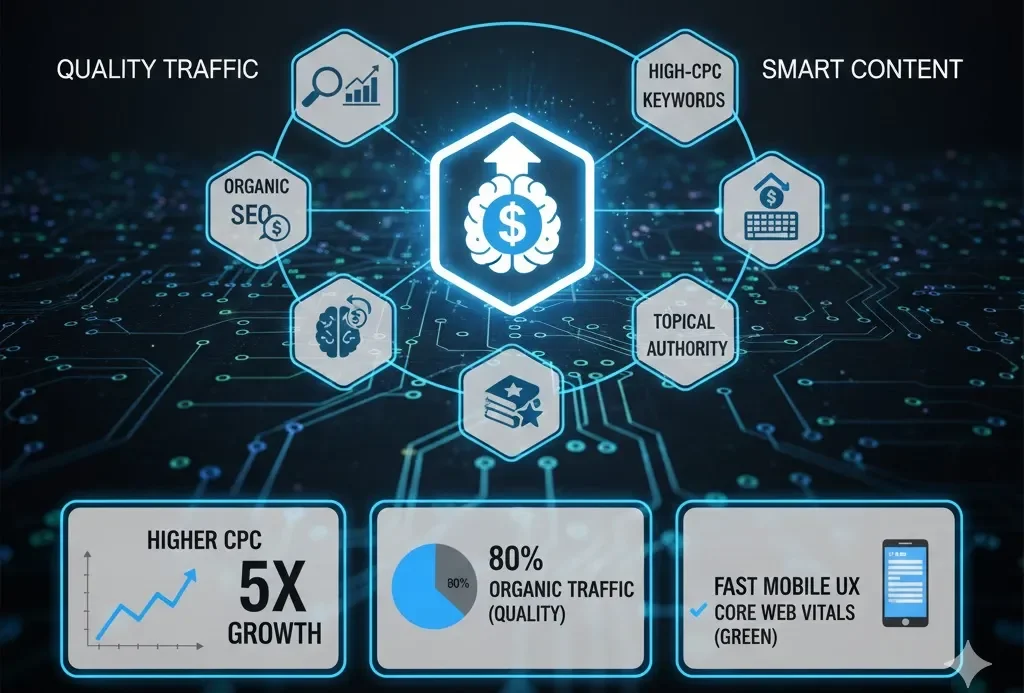
H.1 How to Increase Google AdSense CPC with Better Traffic Quality and Content Strategy (Step‑by‑Step Guide)
For digital publishers, traffic is often viewed as the primary currency of success. However, experienced webmasters know a vital secret: not all traffic is created equal. You can have a site with a million visitors earning a few hundred dollars, or a specialized site with a fraction of that traffic earning thousands. The bridge between these two realities is Cost Per Click (CPC).
In 2025, simply “getting hits” isn’t enough. Advertisers are more selective than ever. To maximize your revenue, you must transition from a general content creator to a strategic publisher who understands how to attract premium bids. This guide will walk you through the nuances of Google AdSense CPC and how to engineer your site for maximum profitability.
H.2 What Is Google AdSense CPC and Why It Matters
Defining AdSense CPC and Its Calculation
Cost Per Click (CPC) represents the amount an advertiser pays you every time a user clicks on an ad displayed on your content. Google manages this through a sophisticated real-time auction. When a visitor lands on your page, Google analyzes the content, the user’s intent, and their browsing history to invite advertisers to bid for that specific ad slot.
To understand your revenue, you can use this simple relationship: Earnings = Total Clicks × Average CPC.
This calculation shows that your income isn’t just about how many people click, but how much those clicks are worth. If you are in a high-value industry like enterprise software or financial services, advertisers are willing to pay a premium because a single lead could result in a high-value sale.
CPC vs. RPM: The Power of Quality
While RPM (Revenue Per Mille) measures how much you earn per 1,000 impressions, CPC is the actual driver behind that number.
Real-Life Example: Imagine you run two different blogs. Blog A is about “Smartphone Wallpapers” where the average CPC is $0.03. Blog B is about “Cybersecurity for Law Firms” where the CPC is $2.10. Even if Blog A gets 50 times more clicks than Blog B, the revenue on Blog B will likely be higher because the value of the user interaction is exponentially greater. This is why targeting high CPC is the most efficient way to scale your income without needing millions of visitors.
H.3 Main Factors That Influence Your AdSense CPC
Niche and Keyword Intent
The niche you choose is the single most important factor for your CPC floor. Advertisers bid based on the Lifetime Value (LTV) of a customer.
-
Informational Intent: Keywords like “what is a mortgage” usually have lower CPC because the user is just looking for a definition.
-
Commercial Intent: Keywords like “best mortgage rates for first-time buyers in London” have much higher CPC. The user is at the end of the decision-making funnel and is ready to take action, making them highly valuable to banks.
Audience Location, Device, and Seasonality
Where your readers live dictates the size of the advertiser’s wallet. Traffic from Tier 1 countries (USA, UK, Canada, Australia) typically sees CPCs that are 5x to 10x higher than Tier 3 regions. This is simply due to the purchasing power of those populations and the level of competition among local advertisers.
Furthermore, keep an eye on Seasonality. During the “Golden Quarter” (October to December), corporate budgets surge for Black Friday and holiday campaigns. You will often see your CPC rise naturally during these months as companies outbid each other for limited ad space.
Website Quality and Brand Safety
Google’s premium advertisers use filters to ensure their ads don’t appear next to “low-quality” content. A site with a clean design, fast loading speeds, and original, expert-led content is considered “brand-safe.” Conversely, sites with excessive ads, thin content, or clickbait titles are flagged by algorithms, leading to lower-value “filler” ads that pay significantly less.
Step 1 – Attract High‑Quality, Intent‑Based Traffic
Prioritize Organic Search Traffic
Organic traffic from search engines is the “gold standard” for AdSense. When someone searches for a specific solution and lands on your page, their intent is focused. This makes them highly attractive to advertisers. Social media traffic, while great for branding, often has “passive intent”—users are browsing for entertainment, which usually leads to lower click-through rates and lower CPC.
Avoid Low‑Quality and Fake Traffic
It is tempting to use traffic bots or “PTC” (Paid-To-Click) schemes to inflate your numbers. Avoid this at all costs. Google’s fraud detection is world-class. If Google detects “invalid traffic,” they won’t just lower your CPC; they might place an “Ad Limit” on your account or ban you entirely. Real engagement from humans who genuinely want to read your content is the only way to build a sustainable high-CPC business.
Step 2 – Choose High‑CPC Keywords and Profitable Topics
Finding the “Gold” Keywords
Use tools like Google Keyword Planner, Semrush, or Ahrefs to look for the “Top of Page Bid” metrics.
-
Focus on Long-Tail Keywords: Instead of targeting the broad term “Credit Cards,” target “Best business credit cards for startups with no credit.”
-
Commercial Modifiers: Incorporate words like Review, Comparison, Alternatives, Pricing, and Best into your titles.
Build Topical Authority
Instead of being a “jack of all trades,” become the master of a micro-niche. If you write about “Home Automation,” create a cluster of articles around “Smart Security Systems.”
Real-Life Example: A site that writes exclusively about “Cloud ERP Software” will almost always have a higher average CPC than a general tech news site. This is because Google’s crawler recognizes the site as a specialized hub, allowing it to serve highly targeted, high-bidding ads to a specific professional audience.
Step 3 – Create Content That Attracts Premium Advertisers
In‑Depth Guides and Tutorials
To attract high CPCs, you need “Cornerstone” content—long-form articles ranging from 1,500 to 3,000 words that solve a specific problem.
-
Use clear headings (H2, H3).
-
Include bullet points and numbered lists.
-
Add screenshots or original charts. The longer a user stays on your page (Dwell Time), the more opportunities Google has to rotate high-value ads.
Product Reviews and Comparisons
“Bottom of the funnel” content is a magnet for high bids. When you compare two software products, the companies themselves are often bidding against each other to show an ad on your page. This competition naturally drives the CPC up.
Optimize for Ad Relevance
Google’s “AdSense Crawler” reads your text to decide which ads to show. If your SEO is vague, the ads will be irrelevant. Ensure your target keyword appears in the Title, URL, first 100 words, and subheadings. This helps the crawler understand that your page is about “Enterprise VPNs” and not just “Internet Tips,” ensuring you get the high-paying ads you deserve.
Step 4 – Improve User Experience and Engagement
Speed and Core Web Vitals
User experience (UX) is a direct revenue driver. If your site takes 5 seconds to load, half your audience will leave before the high-paying ads even render. Use a lightweight theme, optimize your images to WebP format, and utilize a Content Delivery Network (CDN) to ensure your site is lightning-fast globally.
Clean Layout and Navigation
A cluttered site confuses both users and ad crawlers. Use plenty of white space so your ads don’t look like spam. Proper internal linking keeps the user journey going; by linking to related high-CPC articles, you increase the “Page Views per Session,” giving you more chances to earn from every single visitor.
Step 5 – Smart Ad Placement and Layout Optimization
Where to Place Your Ads
-
Above the Fold: A responsive display ad just below the main header or title usually performs best.
-
In-Content: Place ads every 500–700 words. This ensures that as the user reads, they are consistently exposed to relevant offers.
-
The “Conclusion” Ad: Placing an ad near the end of a helpful tutorial is effective because the user has finished their task and is ready to click away to the next thing.
Finding the Right Balance
Don’t turn your site into an “ad farm.” If you have 10 ads on a 1,000-word post, you will frustrate your readers and increase your bounce rate. A good rule of thumb is 3 to 5 well-placed ads for a 2,000-word article. Quality of placement is far more important than the quantity of ads.
Step 6 – Use Data to Monitor and Grow CPC
Analyze AdSense and GA4 Reports
Connect your AdSense account to Google Analytics 4 (GA4). This allows you to identify exactly which pages are your “cash cows.”
Real-Life Example: You might find that a guide on “How to fix a leaky faucet” gets 10,000 hits but only makes $20, while a small review of “High-End Plumbing Software” gets 200 hits but makes $50. Once you see this data, you can pivot your strategy to write more about software and less about DIY fixes.
Common Mistakes That Kill AdSense CPC
-
Thin Content: Publishing short, AI-generated posts that offer no new value. Google identifies this as low-quality.
-
Click-Baiting: Misleading titles that cause users to leave your site immediately.
-
Mixing Niches: Covering everything from “recipes” to “crypto” on the same site prevents you from attracting high-paying, niche-specific advertisers.
Frequently Asked Questions (FAQs)
1. Why is my CPC low even though my traffic is from the USA? Traffic location is only half the battle. If your content is about a low-value topic (like “funny memes” or “daily news”), the CPC will remain low because those visitors aren’t looking to buy anything expensive.
2. Does increasing ad density increase my CPC? No. Overloading a page frustrates readers and increases bounce rates. Advertisers prefer clean, high-authority sites, so a few well-placed ads often yield a higher CPC than dozens of cluttered ones.
3. How long does it take to see an increase in CPC? When you switch to high-value keywords, it typically takes 2 to 4 weeks for Google’s crawler to fully re-categorize your site and for the auction to adjust.
4. Can I use AI to write high-CPC content? Yes, but you must edit it to include real-world examples and unique insights. Generic AI text often leads to “thin content” flags, which reduces CPC.
5. Is Auto Ads better than Manual Ad placement? For 2,000-word content, combining Auto Ads with a few strategic manual placements in the “money spots” (like under the first H2) usually yields the best results.
Final Tips for 2025
Success with AdSense is a marathon. Treat your website as a brand, refresh your high-earning posts annually, and prove your expertise (E-E-A-T). By prioritizing user value over short-term clicks, your CPC will grow steadily and sustainably.


2 Comments on “Increase Google AdSense CPC in 2025 with High‑Quality Traffic & Smart Content Strategy”