Google AdSense Strategy for 2026: New Rules for Higher CPC, RPM, and Safer Monetization
In the rapidly shifting digital landscape of 2026, the old “spray and pray” method of digital publishing—where high traffic volume automatically equaled high revenue—is effectively obsolete. Today’s ecosystem is defined by AI-driven search experiences, stricter privacy regulations, and a profound shift toward topical authority and user intent. To thrive this year, publishers must evolve from being simple “ad displays” into trusted “brand entities.”
If you want to significantly scale your revenue in 2026, you don’t necessarily need millions of new visitors. Instead, you need a strategy that prioritizes high-intent audiences, a brand-safe user experience, and sophisticated data-driven optimization.
Why You Need a New AdSense Strategy in 2026
The transition from 2024–2025 to 2026 has brought seismic changes. Google’s AI Overviews and the integration of Generative AI into search results mean that basic, informational queries are often answered directly on the Search Engine Results Page (SERP). While this has led to a drop in “incidental” traffic for many sites, the traffic that does click through is far more valuable because it carries a clear, decisive intent.
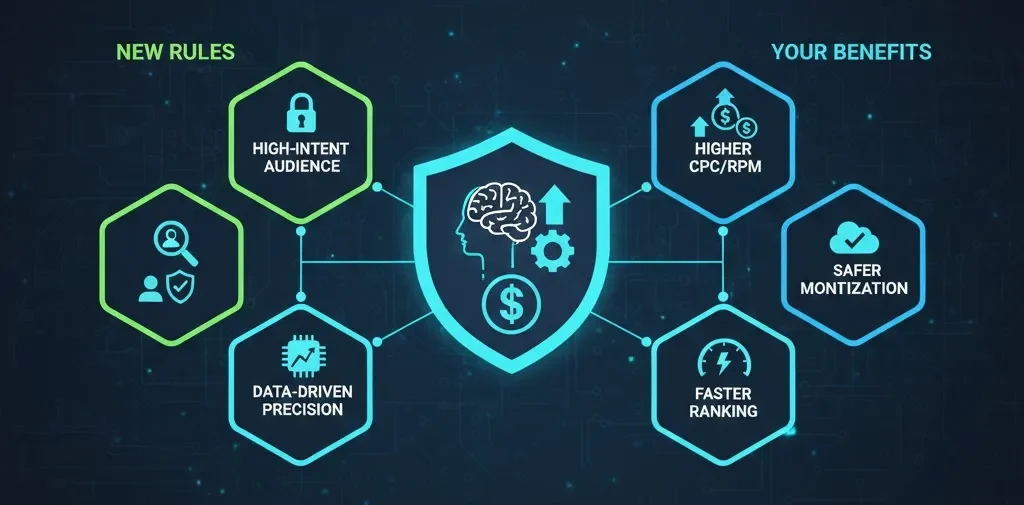
The 2026 mindset is built on three core pillars:
-
High-Intent Audience: Targeting users who are actively seeking a solution, product, or expert advice.
-
Brand-Safe Experience: Ensuring your site is a premium environment where elite advertisers feel safe placing high-value bids.
-
Data-Driven Precision: Moving away from guessing and using tools like GA4 and AdSense experiments to fine-tune every placement.
Core AdSense Metrics to Master in 2026
CPC, RPM, and Page RPM
RPM (Revenue Per Mille) remains the most critical business KPI for any publisher. It represents the estimated earnings you generate for every 1,000 pageviews, providing a high-level view of your monetization efficiency.
The formula for Page RPM is straightforward: Page RPM = (Estimated Earnings ÷ Page Views) × 1000
In 2026, a healthy RPM is driven by the synergy between CPC (Cost Per Click) and CTR (Click-Through Rate). For example, a specialized B2B software blog might have a lower overall CTR but a $4.50 CPC, resulting in a $60 RPM. Conversely, a general news site might have a high CTR but a $0.08 CPC, leading to a much lower $10 RPM. Understanding this mix helps you decide whether to focus on improving ad relevance or attracting a higher-value audience.
Viewability, Session Value, and Engagement
Advertisers in 2026 are aggressively bidding based on Viewability. If an ad is placed at the bottom of a page and the user never scrolls down, that impression is worth almost nothing to an advertiser. Google now prioritizes “Active View” metrics, tracking exactly how long an ad stays “in-view.”
By improving your Session Value (the total revenue generated per user session), you signal to the auction system that your site provides deep engagement. Metrics like pages per session, average engagement time, and scroll depth are the new indicators of a high-quality placement, attracting “Premium Bids” that standard sites miss.
2026 Trend #1 – High-Intent, Brand-Safe Traffic Only
Best Traffic Sources for AdSense in 2026
In 2026, not all traffic is created equal. Random viral clicks from social media or incentivized traffic can actually hurt your account standing by lowering your overall conversion rates for advertisers. The most valuable sources are:
-
Organic Search: Users with a specific problem who find your site through high-value keywords.
-
Email Lists: A loyal, “owned” audience that visits your site repeatedly because they trust your brand.
-
Direct Visitors: Users who bookmark your site, representing the highest level of brand authority.
Avoiding Invalid Traffic and Policy Risks
Invalid Traffic (IVT) is a primary concern for Google in 2026. Updated policies emphasize the protection of advertiser value. Avoid “clickbait” placements that encourage accidental clicks, as these lead to “Smart Pricing,” where Google lowers your CPC to compensate for poor lead quality. Regularly monitor your traffic in GA4 to identify any suspicious spikes from unknown networks and ensure your site uses modern security measures like reCAPTCHA where appropriate.
2026 Trend #2 – UX-First Monetization (No More Ad Farms)
Optimal Ad Density and Layout
Google’s current guidelines recommend a maximum of 30% ad density on mobile screens. Cluttering a page with 10 ads on a 2,000-word post will only frustrate your readers and increase your bounce rate, which ultimately lowers your SEO rankings and RPM.
The 2026 layout strategy favors a “content-first” approach. By keeping the interface clean and using high-quality typography, you keep the user on the page longer. The more time a user spends reading, the more likely they are to engage with a well-placed, relevant advertisement.
Core Web Vitals and Speed as Revenue Drivers
Speed is no longer just a technical checkbox; it is a direct revenue driver. A slow site delays ad rendering, causing users to scroll past ad units before they even appear.
-
CLS (Cumulative Layout Shift): Ensure your ads don’t push the content down as they load, as this is a major policy risk and a UX killer.
-
LCP (Largest Contentful Paint): Your main content should load almost instantly to anchor the user’s attention.
-
Lazy-Loading: Implement lazy-loading for ads so that the browser only requests them when the user is about to reach that specific section of the page.
2026 Trend #3 – Smarter Ad Formats and Placements
High-Performance Ad Formats in 2026
Native and responsive ad units are the dominant formats this year. They are designed to blend into the content seamlessly, reducing “ad blindness” and increasing CTR.
-
Responsive Display Ads: These units automatically adjust their size and format to fit the user’s device.
-
Anchor Ads: These stick to the bottom of the mobile screen. While highly effective, they must have a clear “Dismiss” button to remain policy-compliant.
-
In-Feed Ads: These are perfect for homepage lists or “Related Posts” sections, providing a non-disruptive monetization path.
Placement Blueprints That Don’t Annoy Users
A proven, high-performance placement pattern for long-form content includes:
-
Below the Main Title: High visibility, but should be a responsive unit to avoid overwhelming the intro.
-
After the Introduction, catch the reader just as they have committed to reading the post.
-
Mid-Content: Placed after a significant heading (H2) to break up long blocks of text.
-
Near the Conclusion: Catch the user before they exit the page or move to another article.
Avoid placing ads near navigation menus, “Download” buttons, or “Next” links. These “click-heavy” areas are prone to accidental clicks, which can trigger policy warnings and lower your overall ad quality score.
2026 Trend #4 – Content Strategy Built Around High-Value Niches
Profitable Niches and Topics for 2026
The difference in CPC between niches is more dramatic than ever. Advertisers in 2026 are willing to pay massive premiums for leads in sectors where the lifetime value of a customer is high.
-
SaaS & Business Automation: With companies shifting toward “Agentic AI” and automation, software reviews are incredibly lucrative.
-
Fintech & Personal Finance: Banking, cryptocurrency, and insurance remain the gold standard for high CPCs.
-
Cybersecurity & B2B Tech: As digital threats grow, businesses are spending more on security solutions, driving up ad bids.
Building Topical Authority and E-E-A-T
Google’s E-E-A-T (Experience, Expertise, Authoritativeness, and Trustworthiness) is the foundation of long-term success. Instead of writing random articles, build Content Clusters.
By creating a “Pillar Guide” on a topic like “Cloud Security” and supporting it with 10 detailed articles on specific sub-topics, you prove to Google that you are a comprehensive authority. This not only improves your search rankings but also attracts more relevant, higher-paying ads.
2026 Trend #5 – Data-Driven Optimization with GA4
Finding Your “Money Pages”
Using the GA4 and AdSense integration, you can see exactly which pages are your “cash cows.”
-
Identify Underperformers: If a high-traffic page has a low Page RPM, it usually means the ad placement is poor, or the content is too “broad” to attract high-value ads.
-
Analyze Your Winners: Look at your top-earning pages. Is it the location of the traffic? The specific sub-topic? The length of the content? Use these insights to guide your future content production.
Running Safe A/B Tests
Optimization is an ongoing process. Use the “Experiments” tab in your AdSense dashboard to test different settings.
-
One Variable at a Time: Test only one change (e.g., ad color or Auto Ads vs. Manual) to see its true impact.
-
Two-Week Minimum: Run your tests for at least 14 days to account for weekly traffic fluctuations.
-
The Engagement Guardrail: If an experiment increases revenue but causes a 20% spike in bounce rate, reject it. Your long-term user trust is worth more than a short-term revenue boost.
Building a Safer, Long-Term AdSense Business in 2026
To stay ahead of the curve, you must be proactive rather than reactive. This means staying informed about the latest policy updates and ecosystem changes. In 2026, Google is increasingly focused on User Transparency and Consent (such as TCF v2.3 compliance), so ensuring your consent management platform (CMP) is up to date is a legal and financial necessity.
Furthermore, diversify your income streams without compromising your AdSense health. Layering affiliate links or offering a newsletter subscription can provide additional revenue while AdSense serves as your consistent base income.
FAQs: AdSense in 2026
Is AdSense still worth it compared to other ad networks? Yes. While networks like Mediavine or Raptive are great for high-traffic sites, AdSense remains the most flexible and technologically advanced option for niche sites, especially with its recent AI-driven automation improvements.
What is a “good” RPM for a tech or finance blog in 2026? For these high-value niches, a Page RPM of $40 to $70 is common. For general lifestyle or entertainment, a “good” RPM ranges between $6 and $15, depending on the audience’s location.
How often should I update my old articles? You should review your top 50 earning pages every quarter. Update them with the latest data, new screenshots, and current insights to maintain your “Topical Authority” in the eyes of both Google and the advertisers.
Can small niche sites still get approved easily? Small sites can get approved quickly if they show clear E-E-A-T. A site with 20 high-quality, original articles and a clean, mobile-friendly design is much more likely to be approved than a large site with thin, repetitive content.
What are the biggest mistakes beginners will make in 2026? The most common errors are buying low-quality traffic, using intrusive pop-ups that kill the mobile experience, and relying solely on unedited AI content that lacks the personal insight required for high-CPC ad targeting.
Conclusion
Maximizing your AdSense revenue in 2026 is a balancing act between technical performance and content strategy. By focusing on high-intent topics, optimizing for ad viewability, and always putting the user’s experience first, you build a resilient digital asset. Remember, the most successful publishers this year aren’t the ones with the most ads—they are the ones with the most relevant ads shown to the right people at the perfect time.


2 Comments on “Google AdSense Strategy for 2026: New Rules for Higher CPC, RPM & Safer Monetization”