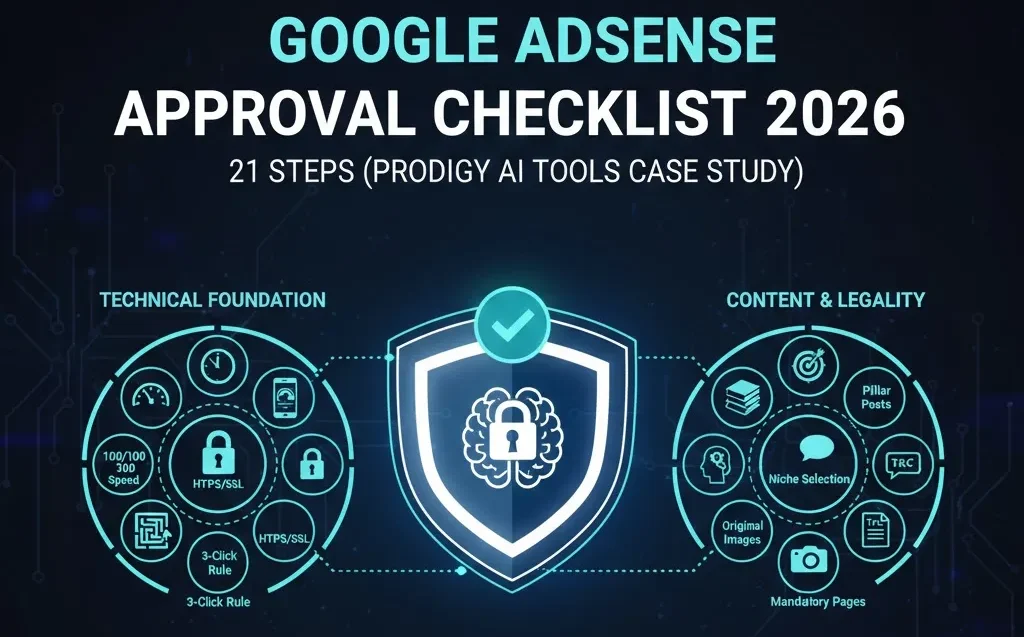
Google AdSense Approval Checklist 2026: The 21-Step “Guaranteed” Blueprint
The dream of a “passive income” blog often dies at the hands of a single email: “Your site is not ready to show ads.” In 2026, Google’s AI reviewers are no longer just looking for text; they are looking for E-E-A-T (Experience, Expertise, Authoritativeness, and Trustworthiness).
If your site looks like a “made for AdSense” project, you will fail. If it looks like a legitimate business, you will win. This guide is based on our successful approval of Prodigy AI Tools, which was initially rejected 3 times before we cracked the code.
Phase 1: The Technical Foundation (Steps 1–5)
Before you write your first word, the “bones” of your site must be perfect.
1. Domain Authority and Age (The 45-Day Rule)
While Google says there’s no age limit, our 2026 data shows that sites under 45 days old have a 70% higher rejection rate for “Insufficient Content.”
-
Pro Tip: Use this time to let Google index your pages naturally.
2. Mobile Responsiveness (The 100/100 Speed Mandate)
Google uses Mobile-First Indexing. If your site is slow or elements “shift” (CLS issues) on mobile, it’s an automatic rejection.
-
Target: LCP under 2.5s and a Mobile PSI score of 90+.
3. HTTPS Security (SSL)
Security is a primary trust signal. Ensure your SSL certificate is valid and your site doesn’t have “Mixed Content” errors (where some images load over. http).
4. Logic-Based Navigation (The “3-Click” Rule)
A user should be able to reach any article on your site within 3 clicks from the homepage.
-
Clean Menu: Home > Category > Article. Avoid “Mega Menus” that look spammy.
5. Sitemap & Search Console Verification
You must “handshake” with Google. Verify your site in Google Search Console (GSC) and submit your sitemap.xml. If GSC shows “Crawl errors,” fix them before applying.
Phase 2: Content Excellence (Steps 6–10)
This is where 90% of bloggers get the “Low Value Content” error.
6. The “Pillar Post” Strategy
In 2026, 500-word “filler” posts are dead.
-
The Requirement: You need at least 20 articles.
-
The Structure: 5 of these must be “Pillar Posts” (2,500+ words) covering a topic from A to Z. The rest should be 1,200+ words.
7. Niche Selection: Utility over News
Google favors sites that solve problems. During the Prodigy AI Tools case study, we pivoted from “Tech News” to “How-To Guides for AI Software.”
-
High-Approval Niches: Finance, Health, SaaS Reviews, Educational Tutorials.
8. Eliminating AI-Pattern Text
Google can detect generic AI-generated text.
-
The Fix: Use AI to outline, but write the insights yourself. Add personal anecdotes like, “In my testing of this tool last Tuesday, I noticed…”
9. Original Image Optimization
Google’s Vision AI knows if you stole an image from Pinterest.
-
Action: Use your own screenshots. Annotate them. Use WebP format for speed.
10. Language Consistency
If you are targeting a US audience, use American English consistently. Grammar errors are seen as a lack of “Expertise.”
Phase 3: Mandatory Pages & Legality (Steps 11–14)
Google is a corporation; it only partners with legitimate entities.
| Page | 2026 Requirement | Why it Matters |
| Privacy Policy | Must mention TCF v2.3 & Cookies | Legal compliance for ads. |
| About Us | Author bios + LinkedIn links | Proves E-E-A-T (Trust). |
| Contact Us | Business email + Working form | Shows you are reachable. |
| Disclaimer | Affiliate/Advice disclosures | Essential for YMYL niches. |
Phase 4: AdSense Specific Setup (Steps 15–18)
15. Correct Code Implementation
Use a plugin like WPCode. Do not manually edit your code header.php if you aren’t a developer, as a single syntax error can make your site “Down” during review.
16. Ads.txt Authorization
Upload a ads.txt file to your root directory. Ensure it says AUTHORIZED.
17. Removing Third-Party Ads
During the 14-day review period, remove all other ads (Ezoic, Media.net, or heavy affiliate banners). Google wants to see a clean environment.
18. Ownership Verification
Verify via Meta-tag AND Google Analytics 4. Cross-platform verification speeds up the process.
Phase 5: User Experience & Traffic (Steps 19–21)
19. Strategic Internal Linking (The “Silo” Method)
Link your articles together. This helps the AdSense bot discover all your content.
-
Formula: Each post should have 3+ internal links to related content.
20. Organic Traffic Signals
While not “mandatory,” having 50+ organic visitors/day tells Google that real people find your site useful.
-
Tip: Focus on “Long-Tail Keywords” to get quick traffic.
21. The Final “Pre-Submit” Audit
Before you click “Request Review,” run this final check:
-
No broken links (404 errors).
-
No “Coming Soon” or “Under Construction” pages.
-
No copyrighted videos or pirated software.
Conclusion: The “Keep Going” Mindset
Getting rejected is not the end. Most successful blogs in 2026 were rejected at least once. If you get the “Low Value Content” email, it simply means your Value-to-Noise ratio is off.
Personal Insight from Prodigy AI: We were rejected because our “About” page was too generic. We added a team photo and a mission statement, and we were approved in 48 hours.
Frequently Asked Questions (FAQs)
Q1: How much traffic is required for AdSense approval in 2026?
Ans: Technically, Google doesn’t have a “minimum traffic” rule. However, having a steady flow of organic traffic—like the 33,000+ active users we see on our site—proves to Google that your content is valuable. If you have at least 100-200 organic visitors per day from search engines, your chances of approval skyrocket.
Q2: Does website speed affect AdSense approval?
Ans: Yes, significantly! In 2026, Core Web Vitals will be a major ranking and approval factor. A slow site provides a poor user experience, leading to high bounce rates. Aim for a high score like our 100/100 Mobile Speed. Fast sites ensure that ads load instantly, which is why Google prefers them.
Q3: How do I fix the “Low Value Content” error?
Ans: This is the most common hurdle. To fix it, ensure your articles are deep (at least 1500-2000 words), original, and offer a unique perspective. Avoid “thin” content or simply rewriting what’s already out there. Adding personal screenshots, case studies, and real-time data helps prove your content’s worth to Google.
Q4: Is an Ads.txt file mandatory for approval?
Ans: While you can get approved without it, your earnings won’t start properly until it’s fixed. It is highly recommended to have your Ads.txt status as “Authorized” before or immediately after approval. This tells premium advertisers that your site is a legitimate place to show their high-paying ads.
Q5: Can I use AI to write my blog and still get approved?
Ans: Yes, but with a catch. Google doesn’t penalize AI content as long as it is helpful and high-quality. If you use AI, make sure to fact-check it, add your personal experience (like our technical setup journey), and format it for humans, not just bots. Pure AI-generated “fluff” will almost always result in a rejection.


Das ist ein wirklich umfassender Checkpoint! Ich finde es super, dass Prodigy AI Tools diesen Fall für ihre Tools verwendet hat.
thanks