Ultimate Guide to AI SEO in 2025: Master Keyword Strategy with GPT and Next-Gen Tools
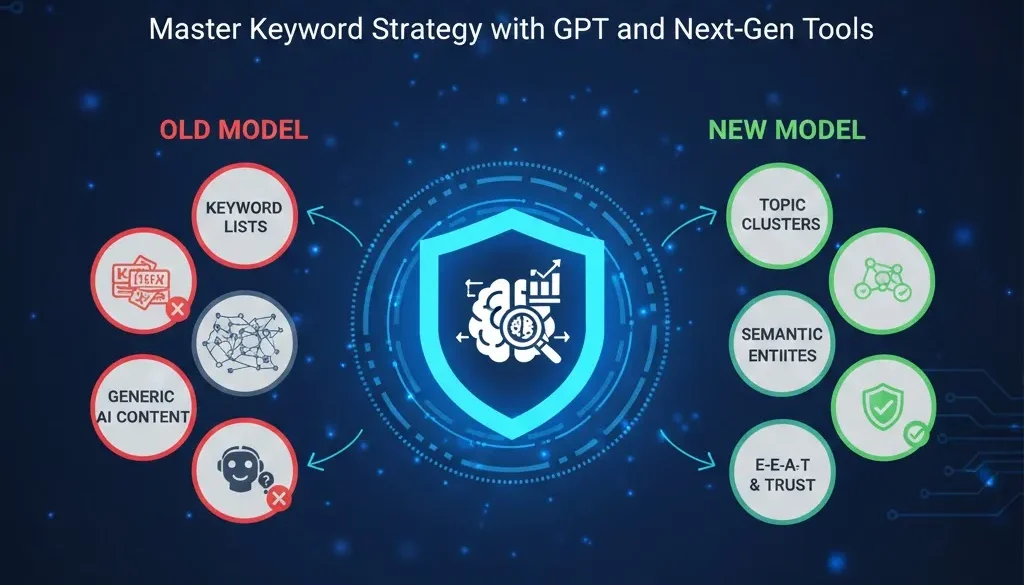
Most teams are still running SEO like it’s 2018: chasing high-volume keywords, obsessing over Domain Authority, and exporting endless competitor reports that nobody ever fully uses.
But search in 2025 is driven by Google’s Search Generative Experience (SGE), large language models like GPT, and semantic search—all of which reward depth, relationships, and topical authority instead of isolated keywords.
The real power of AI SEO is not “auto-writing more articles.” It is using AI to automate strategy: analysing huge amounts of data, revealing what topics your audience truly cares about, which questions they ask, and how to structure content that lets you own an entire niche.
This guide shares a modern AI SEO framework you can plug into your own workflow to move away from outdated keyword lists and start building the one thing Google really cares about in 2025: topical authority.
This guide is for you if you are a Content Strategist, SaaS Founder, Digital Agency, or serious Niche Blogger ready to scale authority, not just volume.
1. The Core Shift: From Keywords to Strategy
For years, the dominant model was simple: find a keyword with good volume, create one article around it, repeat the process, and hope you eventually rank.
The problem is that this approach is entirely backward-looking. Volume and difficulty scores are based on historical data, competition around obvious terms is saturated, and zero-click searches plus SGE mean that even ranking first does not guarantee traffic anymore.
Google now evaluates your overall topical coverage and authority instead of just counting how many times you used a phrase on a single page.
That shifts the role of the SEO from “keyword hunter” to strategist: every new piece of content should answer one question—how does this strengthen my site’s authority on this topic?
2. Semantic Clustering & Topic Authority: The 2025 Blueprint
Modern search is entity- and meaning-driven. Google’s systems model entities (people, brands, tools, concepts) and their relationships, then reward sites that cover a topic deeply and coherently instead of scattering random posts across many themes.
The most practical way to align with this is the pillar & cluster model:
-
The pillar page is a comprehensive guide targeting a broad, high-value topic such as “AI SEO in 2025.”
-
Supporting cluster articles dive into narrower, related questions—for example, “How to Use GPT for Content Briefs,” “AI Tools for Semantic Clustering,” or “AI SEO for Small Sites.”
A healthy cluster looks like this:
-
1 pillar topic with roughly 10–30 focused cluster articles around it.
-
Each cluster targets a specific angle, user question, persona, or tool.
-
Internal links connect everything: the pillar links to all cluster pages, and each cluster links back to the pillar plus 2–3 relevant “sibling” clusters.
Mera Pehla Lesson: “Jab maine sirf ‘AI automation’ par ek generic article likha, woh kabhi properly rank nahi hua. Phir maine alag-alag deep posts banaye – Notion automation, Zapier workflows, Make vs Zapier, real use-cases – aur sab ko ek central ‘AI Automation Guide’ pillar se link kiya. Tab Google ko signal mila ke ‘ye banda sirf keyword nahi chase kar raha, yeh topic actually own kar raha hai.’ Semantic clustering is not optional anymore; it’s the only reliable way to show real expertise.”
3. The AI Tool Stack for Modern SEO
You cannot fight AI-driven search with manual spreadsheets alone. A modern stack combines classic SEO tools with AI systems that handle scale and pattern recognition.
Keyword Research & Ideation
Traditional platforms like Ahrefs and Semrush still provide essential historical data—search volume, difficulty, and competitor snapshots.
But AI-powered tools add the missing context:
-
Tools like SurferSEO or Frase analyse the current top results and identify entities, topics, and supporting phrases you must cover to be semantically complete.
-
GPT-style models can take a seed topic and generate dozens of angles, questions, and content formats that align with user intent instead of just raw volume.
The shift is: raw keyword lists → structured content opportunities.
Content Gaps & Clustering
Manually reviewing 20 competitor sites to find what you’re missing simply doesn’t scale.
Modern AI tools crawl competitor content, highlight topics where they are strong and you are absent, and then group related keywords into logical topic clusters.
That gives you:
-
A visual map of content gaps: what your competitors rank for that you don’t.
-
Auto-generated clusters that can turn into a 3–6 month editorial roadmap with pillar and supporting pieces.
Monitoring & Technical Pattern Spotting
AI will not replace a technical SEO, but it can dramatically amplify one:
-
Log file analysis to reveal crawl budget waste or patterns in how bots hit different sections of the site.
-
Anomaly detection and automated alerts for issues like sudden drops in mobile performance, template-level layout shifts, or indexing problems across a content type.
The principle: let AI mine the haystack, and let humans decide what to do with the needles.
4. Using GPT for Keyword Strategy: Practical Prompt Frameworks
GPT is much more powerful as a semantic strategist than as a simple “keyword ideas” generator—if you give it structured prompts and clear roles.
Framework 1: Generate Pillars and Clusters
-
Role: “Act as a Semantic SEO expert.”
-
Input: A core topic (for example, “AI SEO for beginners”) and a rough description of your audience and language.
-
Output: A markdown table listing pillar-level topics, their related cluster article ideas, primary keywords, and intended user intent.
With one run, you can go from a vague niche to a clear, multi-page cluster map ready to paste into Notion or Sheets.
Framework 2: Long-Tail Questions with Intent
-
Role: “Act as a User Intent Analyst.”
-
Input: Exported keyword lists from Ahrefs or Semrush.
-
Output: A table with each long-tail query, its likely user intent (informational, commercial, transactional, or navigational), plus a short note explaining the intent.
This turns generic keyword dumps into laser-focused content ideas that match searcher psychology.
Framework 3: Content Briefs and Outlines
-
Role: “Act as a Content Brief Writer.”
-
Input: A target cluster keyword and the top 3 ranking URLs (described or summarised, not copied).
-
Output: A structured outline with suggested H2/H3s, must-cover entities, supporting questions, and an estimated word count aligned with the search intent.
Hinglish Moment: “Mujhe yaad hai ek baar main new niche ke liye manual keyword research kar raha tha – Ahrefs me 2–3 ghante lag gaye, fir bhi list thodi generic si lagi. Fir maine GPT ko bola: ‘Act as a semantic SEO strategist, yeh mera topic hai, mere audience beginners hain, mujhe pillars + clusters + intents table me de do.’ 5 minute me jo structure mila, woh manually main shayad ek weekend me bhi na bana pata. Us din laga, ‘game officially change ho chuka hai’.”
5. Persona & Intent Mapping with AI
AI really shines when you feed it messy, real-world data and ask it to find patterns humans would miss.
You can:
-
Paste anonymised support tickets, sales call summaries, and customer chat snippets into GPT and ask it to identify recurring themes and pain points.
-
Then ask it to define 3–4 realistic buyer personas and map which types of queries each persona would search at different funnel stages (awareness, consideration, decision).
For example:
-
Persona 1 – The Creator: searches “best free AI video editing tool” at the awareness stage.
-
Persona 2 – The SaaS Founder: searches “Zapier vs Make comparison for lead routing” at the consideration stage.
-
Persona 3 – The Affiliate Blogger: searches “Tool XYZ discount code” at the decision stage.
Suddenly, your keyword list is no longer abstract—it’s tied to real people with specific needs and buying journeys, which makes your AI SEO strategy far more profitable.
6. Building and Interlinking Clusters: Creating an Authority Web
AI can propose clusters, but you still need to turn those clusters into a navigable “web of authority” that both users and search engines can follow.
Simple Internal Linking Rules
-
Use descriptive, keyword-aligned anchor text such as “our guide to AI content briefs,” not vague text like “click here.”
-
Ensure every cluster article links back to the pillar page and to 2–3 closely related cluster articles.
This gives Google a clear, machine-readable map of how your content fits together and which page is the central authority.
Hinglish Story: “Hamare paas ek ‘Technical SEO’ cluster tha jisme 20 articles already published the, lekin rankings flat thi. Humne AI se poocha, ‘Is topic ke 5–7 important angles kaunse hain jo humne cover hi nahi kiye?’ Naye topics pe fresh content likha, phir purane saare articles me jaa kar proper anchor text ke saath in new posts ke links add kiye. Sirf 4–6 weeks me pure cluster ki impressions aur average positions dono upar chale gaye. Tab realise hua ke content se zyada structure aur linking ne game badla.”
7. E-E-A-T, AdSense Safety, and Human Oversight
In 2025, ranking is not just about speed and volume—it is about trust. Google explicitly evaluates content against E-E-A-T: Experience, Expertise, Authoritativeness, and Trustworthiness.
Human-in-the-Loop as a Rule
Publishing raw AI output at scale is risky and low-value. Winning teams run a human-in-the-loop workflow:
-
Subject-matter experts review and refine AI drafts.
-
Editors add personal anecdotes, screenshots, real workflows, and case-study data that AI cannot invent.
-
Final content is checked for factual accuracy, repetition, and generic “AI flavour.”
This not only protects you against quality issues but also sends clear signals that your site is built around genuine experience, not just generated text.
Strengthening E-E-A-T and Technical Trust
To align with modern guidelines:
-
Include clear author bios that show real qualifications and experience on the topic.
-
Use real examples, metrics, and images where possible to prove you have actually done what you’re teaching.
-
Maintain a clean technical base: fast loading, mobile-friendly pages, HTTPS, and appropriate schema markup for FAQs, how-tos, and reviews.
Hinglish Reminder: “Fast AI content bina trust ke aaj ke time me long-term SEO nahi jeet sakta. AI tumhara accelerator hai, driver tumhe hi banna padega.”
8. Action Plan: Start with a Single Cluster
The easiest way to fail with AI SEO is to try to “AI-ify” your entire site at once. Instead, treat this as a focused experiment.
Here’s a simple five-step plan:
-
Pick one niche where you genuinely have experience – for example, “AI tools for bloggers.”
-
Use the pillar + cluster GPT framework to generate one main pillar and 15 supporting cluster ideas in a table.
-
Validate those ideas with your SEO tools and content gap/clustering tools to confirm what is underserved.
-
Over the next 30 days, publish one strong pillar page and at least three cluster articles, with internal links wired exactly as described.
-
Track performance for 4–6 weeks—impressions, new queries, and how users move between your pages—then double down on what shows early traction.
AI has not replaced SEOs; it has promoted them.
The winners in 2025 will be those who use GPT and next-gen tools to design smarter strategies, then layer on real human experience to build undeniable topic authority. Start with one cluster this week instead of planning the perfect strategy in your head. Small Language Models (SLMs) vs LLMs: Faster, Cheape,r and Smarter AI for 2026Ultimate Guide to AI Workflow Automation: Zapier, ChatGPT, and Notion for 10Productivity Howow to Use AI Content Gap Analysis in 2025 to Steal Competitor Traffic (Ethically)


Sounds like a really helpful overview! It’s great to see people moving beyond just volume keywords – focusing on smarter strategies with AI is definitely the future.