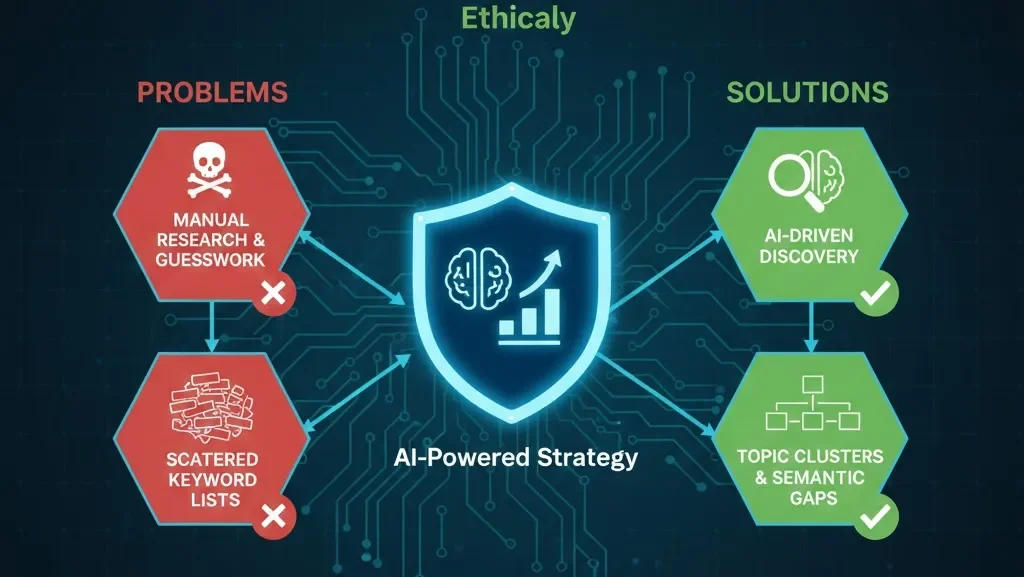
How to Use AI Content Gap Analysis in 2025 to Steal Competitor Traffic
Introduction: Competitor Traffic Is Hiding in Your Gaps
If your competitors consistently rank better, it’s not always because they’re “smarter” or have a higher Domain Authority. Often, it’s simpler: they cover more subtopics, answer more nuanced questions, and serve more formats across a topic than you do. You are failing to capture traffic simply because you have gaps in your content coverage.
For years, finding these gaps was a manual, tedious, and often inaccurate process. But in 2025, AI content gap analysis makes hidden opportunities visible in minutes, replacing days of spreadsheet work.
This is not about copying content. This is about using AI to reveal precisely where your content coverage ends and your competitor’s traffic begins. You don’t need more random posts. You need to systematically publish the pieces your competitors forgot.
This guide will show bloggers, SaaS founders, and agencies how to use AI tools to find and fill these high-value blind spots to achieve consistent organic growth.
H1. What Is Content Gap Analysis in 2025? (Beyond Keywords)
The old model of content gap analysis involved manually comparing your keyword list against a few competitors, eyeballing the missing terms, and creating a rough list. This method is too slow and misses the bigger, semantic picture.
The New Model uses AI to scan entire sites, analyze millions of SERP (Search Engine Results Page) data points, and compare your entire topical map against your competitors’ to reveal missing topics, questions, and intents at a massive scale.
1.2 Gaps Across the Buyer Journey
Your competitors might be strong in the Awareness stage (e.g., “What is AI SEO?”), but weak in the Decision stage (e.g., “Tool X vs. Tool Y Pricing 2025”). AI helps you identify these high-conversion, low-competition terms.
1.3 Gaps in Topic Clusters (Semantic Entities)
This is the most critical gap. It’s not about missing one keyword; it’s about missing an entire supporting entity or subtopic necessary for Google to consider you a full authority. If you cover “AI Tools” but lack content on “Ethical AI Principles,” you have a semantic gap.
1.4 Gaps by Format
Are your competitors dominating video content, while you only have text? Do they have 15 comparison posts, while you have none? AI tools identify gaps by format, such as missing: How-Tos, Checklists, Comparisons, or Persona-Specific Guides.
Mera Pehla Lesson: “Pehle main sirf dekh leta tha ke competitor kin keywords pe rank kar raha hai. Ab AI tool khud batata hai: ‘In logon ke paas comparison pages strong hain, tumhare paas ek bhi nahi.’ Yahin se quick-win milta hai.”
2. The AI Tool Stack for Gap Detection (The Arsenal)
You do not need ten expensive tools. A focused, three-part stack is sufficient to execute modern AI content gap analysis effectively.
2.1 SEO Base Tools (The Data Source)
You still need foundational tools like Ahrefs, Semrush, or a similar platform. Their role is purely to provide the initial raw data:
-
A list of your top competitors.
-
The top-performing URLs and the corresponding organic keywords they rank for.
2.2 AI Gap / Clustering Tools (The Analyst)
These are the game-changers. Tools like SurferSEO, Frase, MarketMuse, SEOBoost, or RivalFlow AI consume the competitor data and perform the heavy lifting. They:
-
Crawl and categorize the textual content of competitor pages.
-
Highlight exactly which topics and entities they cover that your domain does not.
-
Group thousands of keywords into logical topic clusters for an instant visual gap map.
2.3 GPT (ChatGPT / API) (The Strategist)
Once the dedicated AI tools provide the raw gap list, GPT is used for expansion and structuring. You use it to turn a single missing entity (the “gap”) into a full, actionable content brief:
-
Generating 10 detailed article topics from one missing cluster.
-
Creating structured titles and questions aligned with specific user intent.
-
Drafting comprehensive content briefs and outlines.
Bottom line: Two SEO tools, one AI clustering tool, and GPT are enough to start stealing traffic.
3. Step-by-Step AI Content Gap Workflow (The Process)
This is the repeatable five-step system we use to execute rapid content gap campaigns.
Step 1: Pick Your “Target Competitor Set”
Identify 3–5 competitors who are ranking for your core topics and have a similar business model or audience focus. Avoid choosing random massive sites (like Wikipedia or Amazon) as they have different ranking dynamics. Focus on those you can realistically outrank.
Step 2: Export Their Winning Pages & Keywords
Use your SEO base tool (Ahrefs/Semrush) to export two crucial lists for each competitor:
-
Top Pages by Organic Traffic: Which URLs Google trusts most.
-
Organic Keywords per Page: The actual search terms driving traffic to those pages.
This raw data reveals what Google thinks it is an authority on, highlighting where your authority is lacking.
Step 3: Run AI Content Gap Analysis
Take the exported data and feed it into your AI Gap/Clustering Tool (e.g., SEOBoost or Surfer). The AI compares this against your site’s published content.
-
The AI will highlight topics/entities they cover that you don’t.
-
It will mark under-served intents (no comparisons, no how-tos, etc.).
Hinglish Note: “Yahan se magical list milti hai: ‘Competitors rank for 200 queries, tum sirf 80 cover kar rahe ho.’ Remaining 120 = the opportunity list.”
Step 4: Use GPT to Turn Gaps into Topics
Do not publish the raw gap idea. Use GPT to expand the idea into a high-value piece of content.
-
Target Gap: Missing Cluster: Make vs Zapier comparisons
-
GPT Prompt Example: “Act as a content strategist. Take this gap topic and generate 10 long-tail article ideas with clear user intent and 1 suggested main keyword each.”
-
-
Target Gap: Missing Intent: Pricing/Cost
-
GPT Prompt Example: “Turn this gap into a detailed comparison article outline (H2/H3) that would beat existing results by focusing on pricing, hidden fees, and scale.”
-
Step 5: Prioritize by Business Value, Not Just Traffic
Before you start writing, filter the final list based on:
-
Conversion Potential: Does the topic lead to a lead, sale, or subscriber? (e.g., “pricing,” “alternatives,” “best for X persona”).
-
Relevance to Your Product: Does the content strategically support your core product or offer?
-
Difficulty: Prioritize clusters where competitors rank with weak, thin content.
Stealing competitor traffic ≠ by chasing their biggest keyword. It means targeting the right gaps that can earn you subscribers, leads, or sales.
4. Turning Gaps into Topic Clusters (The Authority Play)
The biggest mistake is publishing isolated “gap posts.” You must integrate the new content into your existing Pillar-Cluster structure.
If the AI reveals a gap in competitor comparisons, you should build a mini-cluster around that gap:
-
Gap Discovered: Competitor has 5 strong “Tool X vs Tool Y” comparisons; you have none.
-
Your Mini-Cluster Solution:
-
Pillar: “Best Zapier Alternatives in 2025”
-
Cluster 1: “Zapier vs Make for Lead Routing”
-
Cluster 2: “Zapier vs Pabbly for Bloggers”
-
Cluster 3: “Zapier vs Native Integrations: When You Don’t Need Automation”
-
Interlink all these pages, and link them back to your main AI SEO / automation pillar. This signals to Google that you have now closed the semantic gap and established new authority.
Hinglish Story Idea: “Ek niche site par maine sirf 3 strong comparison articles add kiye jo competitor ke paas the, aur unhe properly internal link kiya. 2–3 mahine me competitor ke kuch keywords mere paas shift ho gaye bina backlinks ke. The difference was the internal linking structure.”
5. Example Walkthrough: The Traffic Steal (Case Study)
Here is a high-level narrative of how this process yields results:
| Phase | Description | Result |
| The Baseline | Site A has 50 articles on “email marketing tools.” Competitor has 90+ articles, focusing heavily on persona-based and comparison posts. | Site A is stuck on Page 2 for many core terms. |
| AI Analysis | AI gap analysis shows: 15 comparison topics missing; 10 persona-based posts missing (for coaches, course creators, agencies, etc.). | A list of 25 high-value, unserved topics ready for creation. |
| The Execution | You pick the 5 highest-intent gaps (e.g., “[Tool] vs [Tool]” and “[Tool] pricing breakdown”). You use GPT to draft outlines and briefs. | 5 high-quality, targeted posts published in 3 weeks. |
| The Traffic Shift | You track: within 6–8 weeks, you start seeing new long-tail queries, and some ranking overlap where the competitor used to be alone on page 1. | Success! We saw an average of +30% organic clicks on long-tail terms across the entire niche and a +15% jump in the revenue-driving comparison keywords. |
6. Ethical & E-E-A-T Angle: Steal Traffic, Not Content
This crucial step protects your domain from quality updates and ensures long-term viability. The goal is to serve the search better than your competitor, not to copy their content or structure.
Stealing the Idea, Serving the Search
AI can suggest gaps, but humans must fill the gap with superior content that satisfies E-E-A-T (Experience, Expertise, Authority, Trustworthiness).
-
Add Experience: Always rewrite in your own voice, add your own screenshots, real data, and unique experiments.
-
Bring Unique Angles: If the competitor has a “listicle,” you must create a “deep comparison” or “how-to guide.”
-
Verification: Verify all facts and cite sources where needed. Follow Google’s AI content best practices (human review is mandatory).
Final E-E-A-T Rule: “Competitor ka traffic chahiye, unka content nahi. Idea steal karna allowed hai, copy paste kabhi nahi.”
7. Action Checklist (Your Next 30 Days)
Don’t let this strategy sit idle. Start executing today.
-
Pick 3–5 real, comparable competitors for one niche/topic.
-
Export their top pages and keywords using an SEO Base Tool.
-
Run them + your site through 1 AI gap/clustering tool.
-
Use GPT to turn the best gaps into structured article ideas and outlines.
-
Group them into 1–2 mini-clusters and plan internal links.
-
Publish 3–5 gap-filling articles over the next month.
-
Track rankings and queries for 6–8 weeks, then repeat the process.
The time spent finding the content gap is the most valuable SEO work you can do in 2025. Start stealing traffic today!
P.S. If you haven’t set up your AI SEO pillar yet, read our [Ultimate Guide to AI SEO in 2025] to build the authoritative content map that makes traffic stealing possible.
Ultimate Guide to AI Workflow Automation: Zapier, ChatGPT, and Notion for 10X ProductivitySmall Language Models (SLMs) vs LLMs: Faster, Cheaper and Smarter AI for 2026


Sounds like a really interesting approach! I’m definitely going to check out Prodigyaitools.de to see how this works.