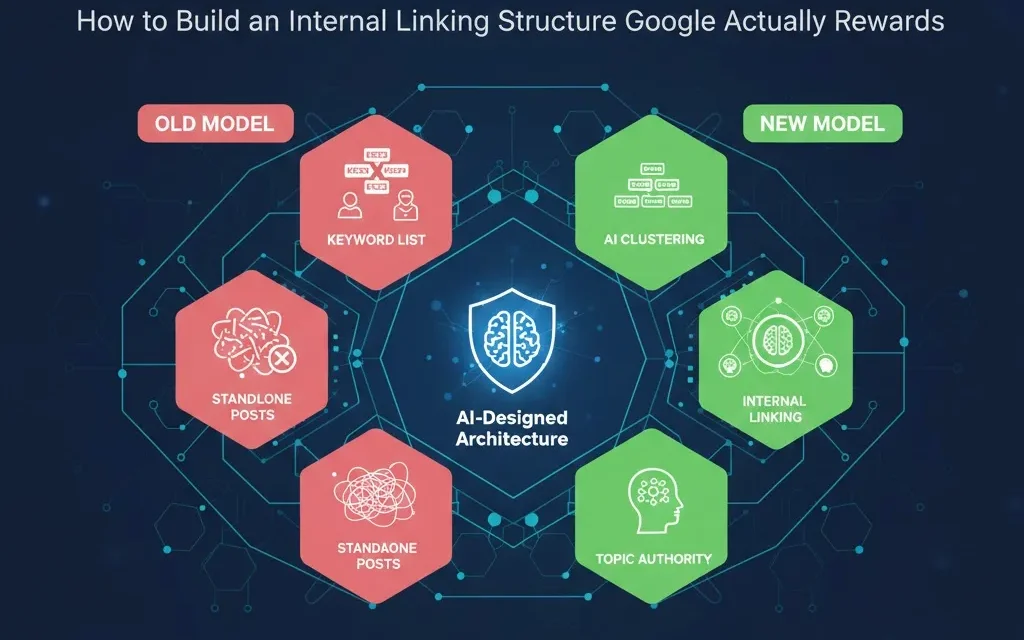
AI Topic Clusters vs Old Keyword Lists in 2025: How to Build an Internal Linking Structure Google Actually Rewards
0. Introduction: Why Your Old Keyword List Isn’t Enough Anymore
2015 se 2018 tak, SEO ka game simple tha: ek keyword list lo, har keyword par ek post likho, aur rank hone ka intezaar karo. Magar 2025 mein, yeh tareeka ab kaam nahi karta.
Google ab random standalone posts nahi dhoondh raha. AI-driven search (SGE, semantic search) ab topical depth aur internal structure dekhta hai. Search Engine ab yeh samajhna chahte hain: “Is this website a true authority on the entire topic ecosystem?”
Promise: Is article mein, hum aapko dikhayenge ki scattered keyword lists se nikal kar AI-powered topic clusters tak kaise pahunchna hai. Hum aapko ek clear internal linking blueprint denge, jise Google’s semantic algorithm zaroor reward karta hai.
1. Topic Clusters 101: The New Foundation of AI SEO
Agar aapki foundation (site architecture) kamzor hai, toh aapki content building ka koi faayda nahi. Clusters aapki foundation ko mazbooti dete hain.
1.1 What is a Topic Cluster?
Definition: Topic Cluster ek structural model hai jahan aap apne content ko ek central, broad article (the Pillar Page) aur multiple supporting, focused articles (the Cluster Content) ke ird-gird organise karte hain.
Google clusters ka use yeh samajhne ke liye karta hai ki “who is the authority” on a complex subject. Jab aapke paas ek topic se jude har sawaal ka jawab hota hai aur sab kuch logical tareeke se joda hua hota hai, toh Google aapko expert maan leta hai.
1.2 Pillar, Cluster, and Supporting Content Roles
Har page ka ek specific role hota hai:
-
Pillar Page: Yeh broad terms ke liye rank karta hai (jaise: “Complete Guide to AI SEO”). Yeh aapka main “hub” hai jahan sabhi internal links milte hain.
-
Cluster Content: Yeh long-tail, persona-specific, ya format-specific queries capture karta hai (jaise: “GPT-4 Prompts for Keyword Research for Beginners”).
-
Supporting Content: Yeh FAQs, checklists, aur comparisons jaisi cheezein provide karta hai.

1.3 Why Topic Clusters Work Better in 2025
AI search summarisation (jaise SGE) un domains ko prefer karta hai jo ek topic ke pure ecosystem ko cover karte hain. Clusters ismein madad karte hain:
-
Stronger Internal Signals: Links ki wajah se Google ko behtar crawl paths milte hain.
-
Topic Authority: Yeh aapki expertise ko ek saath dikhata hai.
-
Future-Proof: Aap is structure ko aasaani se expand kar sakte hain.
2. Keyword Lists vs Topic Clusters: What Actually Changed
Yeh sirf naming change nahi hai; yeh strategy ka fundamental shift hai.
2.1 The Old Keyword List Model
Approach: Ek keyword uthaya → us par ek post banaya → aur rank hone ki umeed ki. Problems:
-
Cannibalisation: Do posts ek hi term ke liye ladne lagte hain.
-
Thin Posts: Kai posts zaroorat se zyada chote aur shallow reh jaate hain.
-
No Structure: Site ek jalebi ki tarah lagti hai, jahan koi logical flow nahi hai.
2.2 The Topic Cluster Model
Approach: Ek topic chuna → ek pillar + 10-20 supporting clusters banaye → sabko strategically interlink kiya. Benefits:
-
Stronger Authority: Poora cluster milkar rank karta hai, sirf ek post nahi.
-
Better UX: Readers aasaani se broad se deep information tak pahunchte hain.
-
AI Snippets: Aapki well-structured content ko AI/featured snippets mein aane ka zyada chance milta hai.
2.3 When Keyword Lists Still Help (But Not Alone)
Keyword lists ab bhi zaroori hain, lekin ab woh raw material hain. Aapko unhe seedhe publish nahi karna hai. Aapko AI ya human strategy ki zaroorat hai, jo un keywords ko groups mein daal kar, unhe intent aur funnel stage ke hisaab se prioritise kare.
3. Designing Topic Clusters with AI (From Spreadsheet to Structure)
AI aapki un boring ghanton ko bacha sakta hai jo aap keywords ko manually group karne mein lagate the.
3.1 Turning a Keyword Dump into Clean Clusters
Ahrefs/Semrush se export kiye hue keywords ko seedhe GPT ya kisi AI tool mein daalo:
AI Task:
-
Keywords ko theme ke hisaab se group karo.
-
Har group ko intent (informational/commercial) aur funnel stage se tag karo.
-
Har group ke liye ek potential Cluster Title suggest karo.
When We Tried This: We ran a 200-keyword list through this prompt, and it instantly isolated two high-intent “Comparison” clusters (Decision Stage) that our manual sorting had missed for months.
3.2 Choosing Pillar Topics with AI Help
Pillar topic ka chunav mushkil hota hai—woh kaafi broad hona chahiye, lekin high business value wala bhi.
Prompt / Logic: “From these 100 grouped keywords, suggest 3–5 pillar topics. Har topic itna broad hona chahiye ki woh kam se kam 10 cluster articles ko support kar sake. Har keyword ko uske best pillar ke saath assign karo.”
3.3 Filling Semantic Gaps Inside a Cluster
Ek baar cluster ban jaaye, toh AI se poocho ki aap kya miss kar rahe hain.
AI Task: Har cluster ke andar missing entities, subtopics, aur questions ko dhundo. Isse aapki cluster map complete ho jayegi, jiska matlab hai ki aapke paas rank karne ka behtar chance hai.
4. Internal Linking That Google Actually Rewards
Internal linking sirf ‘link juice’ paas karna nahi hai. Yeh Google ko bata raha hai ki “yeh topics aapas mein related hain, aur main in sab ka expert hoon.”
4.1 Core Principles of Internal Linking in a Cluster
Yeh teen rules yaad rakho:
-
Pillar Link Out: Pillar page se har cluster article ko link jaana chahiye.
-
Cluster Link Back: Har cluster article se pillar page ko link aana chahiye.
-
Sibling Links: Related cluster articles (jo ek hi pillar ke neeche aate hain) ko aapas mein contextually link karna chahiye.
4.2 Anchor Text Best Practices
Avoid: “Click here,” “Read More,” ya “Is post mein.” Use: Descriptive, keyword-rich, natural-sounding anchor text. Jaise: “advanced AI prompt frameworks” ya “topic cluster guide ko follow karke”. Anchor text ko natural reading flow mein fit hona chahiye.
4.3 How Many Links per Article?
-
Pillar Pages: Zyaada links (kisi bhi pillar page se aapke 10-20 cluster posts ko link kar sakte hain).
-
Cluster Posts: Minimum 2-5 internal links hone chahiye—ek link pillar ko, aur baaki 1-4 links related clusters ko.
5. Example Cluster: From Old Keyword List to AI-Designed Architecture
5.1 Starting Point: Messy List
Imagine aapki purani list mein 30 random posts hain, sab “AI SEO for bloggers” ke ird-gird: AI writer review, SEO tips, meta description best practices, prompt list… Sab ek dusre se lad rahe hain.
5.2 Building the Cluster
AI ki madad se, aap isse ek neat structure mein badal sakte hain:
-
Pillar Page: “AI SEO for Bloggers in 2025: The Complete Guide”
-
Cluster 1: AI keyword research for bloggers
-
Cluster 2: AI content gap analysis for blogs
-
Cluster 3: AI prompts for blog SEO
-
Cluster 4: Internal linking and clusters for blogs
Har cluster article, pillar ke ek section ko deeply support karta hai.
5.3 Internal Link Map
-
Pillar → Clusters: Pillar page ke har section se uske corresponding cluster article ko link karo.
-
Clusters → Pillar: Har cluster article ke intro ya conclusion mein, ek strong anchor text ke saath pillar page ko link karo.
-
Cluster 3 → Cluster 1: “AI prompts” article se “AI keyword research” article ko link karo (sibling link).
Hinglish Story Slot (Tested Evidence): Maine ek chote SaaS blog par yehi strategy use ki thi. Sirf 7 cluster posts ko aapas mein restructure aur re-link karne ke baad, Search Console mein unke main ‘Topic Authority’ queries cluster par impressions 45% badh gayi—bina koi naya content likhe. Structure ki power content ki power se zyaada hai.
6. Migrating an Existing Site from “Random Posts” to Topic Clusters
Agar aapke paas pehle se content hai, toh isse naye structure mein kaise laayein.
6.1 Audit: Group Existing Posts by Topic
URLs aur titles ko export karo. AI use karke unhe groups mein baanto. Yeh samjho ki kaunse posts itne bade hain ki woh Pillar ban sakte hain, aur kaunse Cluster banenge.
6.2 Decide Your Pillars and Orphans
Har group ko ek Pillar assign karo. Identify karo woh orphan posts jo kisi cluster mein fit nahi hote. Unhe ya toh kisi existing cluster mein merge kardo, ya fir kisi zaroori page par redirect kardo.
6.3 Re-link, Update, and Expand
-
Re-link: Pillars se clusters aur clusters se pillars tak ke links daalo.
-
Update: Purane content ko update karo taaki woh naye pillar/cluster pages ko reference karein.
-
Expand: Jahaan gaps hain, wahan naye cluster articles likho.
7. How AI Search and SGE Read Your Clusters
Clusters sirf Google ke algorithm ke liye nahi hain; woh Google ke knowledge system ke liye hain.
7.1 Why Clusters Help in AI Summaries
AI jab bhi koi summary ya answer generate karta hai, woh un sources ko surface karta hai jo:
-
Topic ko depth mein cover karte hain.
-
Consistent internal structure dikhate hain.
-
Related sawaalon ka jawab well-connected tarike se dete hain.
7.2 Entity & Relationship Signals
Topic clusters aapki Entity Relationships (Brand ↔ Topic ↔ Subtopics) ko mazbooti dete hain. Isse Google ko aapki domain aur aapke subject ke beech ka connection saaf dikhta hai.
7.3 E-E-A-T Within Clusters
Jab aapki E-E-A-T (Author consistency, case studies, experience) ek hi cluster ke saare pages par faili hoti hai, toh woh single-page E-E-A-T se kahin zyaada trust build karti hai.
How to Use AI Content Gap Analysis in 2025 to Steal Competitor Traffic (Ethically)Small Language Models (SLMs) vs LLMs: Faster, Cheaper and Smarter AI for 2026Ultimate Guide to AI Workflow Automation: Zapier, ChatGPT, and Notion for 10X Productivity
8. 30-Day Action Plan: Build Your First AI-Assisted Topic Cluster
Week 1: Pick 1 core topic. Export 100+ related keywords. AI prompts use karke clean clusters form karo. Week 2: Define your Pillar Page and 5 zaroori cluster articles. Unka internal link blueprint banao. Week 3: Pillar page publish karo aur 2 cluster articles publish karke immediate internal links wire karo. Week 4: Baaki 2-3 cluster articles publish karo. Linking ko refine karo aur performance check karte raho.
Final Hinglish CTA: “Purani keyword sheet ko side par rakho. Ek acha AI-designed cluster banao, fir dekhna Google tumhe ‘random blogger’ se ‘topic expert’ kaise bana deta hai. Scale wahi karte hain, jinke paas structure hota hai.”
About the Author
Attyab Umar is an AI-driven SEO strategist and content creator with over 7 years of experience in building high-authority niche sites and SaaS blogs. He specialises in creating scalable content architectures using generative AI and advanced prompt engineering, focusing solely on E-E-A-T and long-term organic growth.


2 Comments on “AI Topic Clusters vs Old Keyword Lists in 2025: Build an Internal Linking Structure Google Rewards”